
Dumfries and Galloway College Heritage Trail • Stop 2
Supporting Business & the Community
Working with employers to shape skills, careers and the regional economy.
Listen to this stop
This stop explores the College’s relationship with local businesses.
Read the video transcript
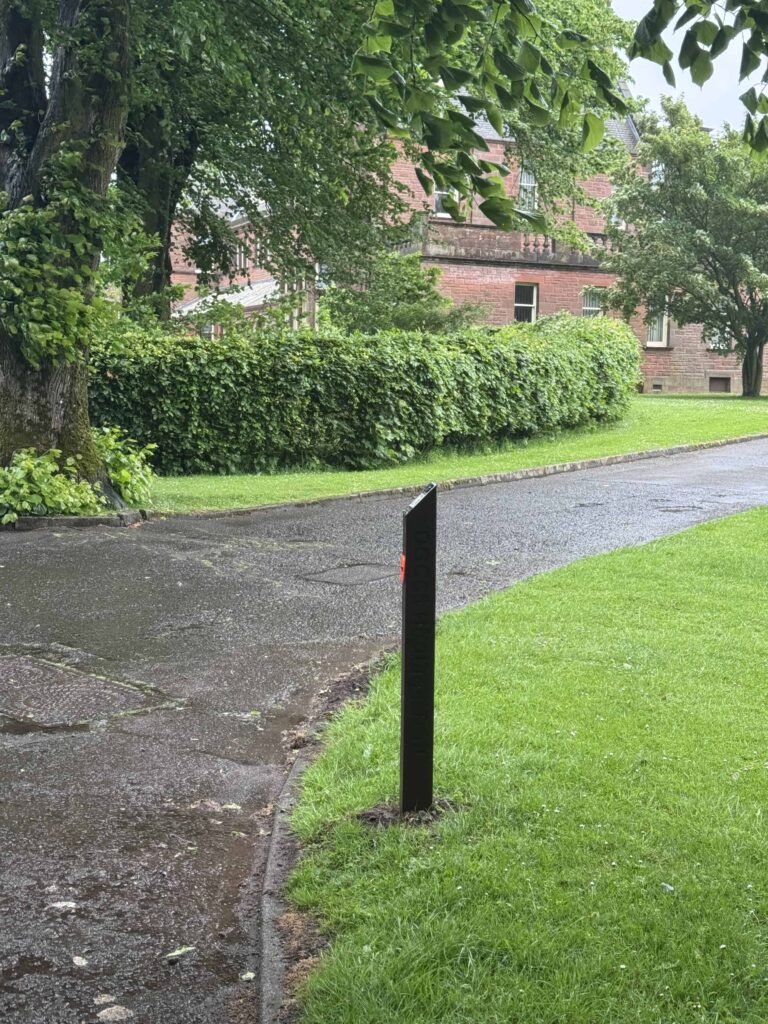
Trail marker 2, DGC supporting business and the local economy.
You’re now standing overlooking Carmont House, the current home to the Dumfries and Galloway Chamber of Commerce and the South of Scotland Enterprise. Through its long-standing relationship with the Chamber and SOSE, the College has worked closely with local businesses to shape skills, create opportunities and support the growth of the region’s economy.
For more than six decades, Dumfries and Galloway College has supported the region’s economy by developing a wide variety of educational pathways, where a skilled local workforce come to learn, develop and thrive. From engineering and construction training in the early years to modern apprenticeships and industry partnerships today, the College has always worked closely with businesses to support and develop the workforce needed for the region. At the same time providing career pathways and employment opportunities.
Graham Galloway, Director of Dumfries and Galloway Developing the Young Workforce, talks about the support they give to the College and employers for the workforce opportunities of the future:
“And our job really is quite a lot of the time to actually open young people’s eyes to what is available to them because there’s a whole raft of industry within the region. Some of it very, very specialised and European leaders that maybe young people have not heard about or understand that that is an opportunity for them within the region. And equally it’s about the College and ourselves listening to businesses to say what are the opportunities that are becoming available with modern technology.”
As the region’s employment opportunities have changed over the years, the College has adapted. New programmes have emerged to support sectors such as healthcare, digital technologies, tourism and renewable energy. By listening to employers, big and small, and responding to the needs of the local economy, the College continues to ensure that its students are prepared for real careers.
Former board member Richard Nash, who works for Natural Power, reflects on the importance of working with the College on new technologies.
“I think one of the other proudest moments has to be working with the company that I work for, which is a company called Natural Power. I saw an opportunity between the business that I work for and the College and the opportunity was around the turbine technician course. There is something aspirational about being trained and being employed in an industry that is doing its bit to save the planet or decarbonise the world, or even more simplistically than that, you’re just part of an energy transition into the electrification of renewable energy. What a world to be in.”
By combining education with real-world experience, the College helps students gain the knowledge, skills and confidence required to contribute to the region’s future economy. Partnerships with businesses play an important role in this work.
Leona Seaton, Assistant Principal for the Commercial Growth and Strategy at the College, looks at the way in which the College works with local employers across the region.
“We are looking clearly to support economic growth and development in the region, to support businesses, to grow and sustain and find the talent that’s required for them in our region. Then there’s people’s personal and professional development, so people who might be looking for a career change or to move into a certain sector. Then there’s those opportunities. But then there’s also the opportunity, and I think you touched on the word community, there’s the opportunity for people who want to come together, whether that’s on a master chef course and meet other people, not necessarily to be a chef, to do something for the enjoyment of learning.”
Employers contribute to course design, offer work placements and provide valuable insight to the skills that industry requires. For many students, this means that their learning goes beyond the classroom and into real workplaces across the region. From large industries to micro-businesses, they all thrive here in the region and are supported by the college to grow.
Working with industry
For more than six decades, Dumfries and Galloway College has supported the region’s economy by developing the skilled workforce local employers need.
From its early focus on engineering and commercial training, the College has always worked closely with businesses and continues to adapt as industries evolve.


Learning beyond the classroom
By combining education with real-world experience, students gain the skills and confidence needed for employment.
Employers help shape courses, offer placements and provide insight into industry needs.
Take a moment to reflect
How has education influenced the services and businesses you rely on every day?
Continue the trail
As you continue to the next marker, discover how Dumfries and Galloway College has partnered with universities to create pathways for learners.